
The Sea Trial in Pre-Purchase Inspections: Why It Is Essential When Buying a Boat

Buying a second-hand boat is a major decision, both financially and emotionally. Prospective buyers often focus on the vessel’s appearance, interior condition, equipment list, or available documentation. However, there is one critical phase of a professional pre-purchase inspection that cannot be replaced by any visual check alone: the sea trial.
Within a professional pre-purchase survey, the sea trial is the moment when the boat stops being a promise and becomes a reality. It is the only phase that allows the surveyor to assess how the vessel truly performs under real operating conditions and to identify issues that would otherwise remain hidden.
What Is a Sea Trial in a Pre-Purchase Inspection?
A sea trial is not a leisure cruise, nor a marketing demonstration. It is a structured technical test, carried out following a defined procedure and based on direct observation and analysis.
Its purpose is to evaluate the dynamic behaviour of the vessel and the real-world performance of her main systems. This is something that simply cannot be assessed while the boat is moored or out of the water.
During a sea trial, the boat is operated:
-
Under load
-
At different engine speeds
-
During real manoeuvres
-
In normal navigation conditions
In short, it is the only way to confirm whether the boat actually performs as it should.
Static Inspection vs Sea Trial


A complete pre-purchase inspection normally includes three different situations:
Inspection Afloat (Alongside)
This allows the surveyor to inspect interiors, electrical systems, safety equipment, visible machinery and general condition. However, the vessel is static and not working under load.
Inspection Ashore (Haul-Out)
Essential for evaluating the hull, underwater fittings, propellers, shafts, rudders, anodes and structural elements. The boat, however, is not operating.
Sea Trial
The only phase where the vessel is navigated, accelerated and manoeuvred as she would be in real use.
Without a sea trial, a pre-purchase inspection cannot be considered complete, as the real interaction between hull, propulsion and steering systems remains untested.
What Is Evaluated During a Professional Sea Trial


Propulsion and Machinery
The sea trial provides essential information about the condition and performance of engines and drivetrain components:
-
Cold and warm engine starts
-
Idle stability
-
Throttle response
-
Cruising RPM
-
Maximum RPM achieved
-
Operating temperatures and pressures
-
Alarm behaviour
-
Smoke, vibration or abnormal noise
-
Gearbox and transmission performance
It is not uncommon for engines to appear satisfactory at the dock while failing to deliver correct performance under load.
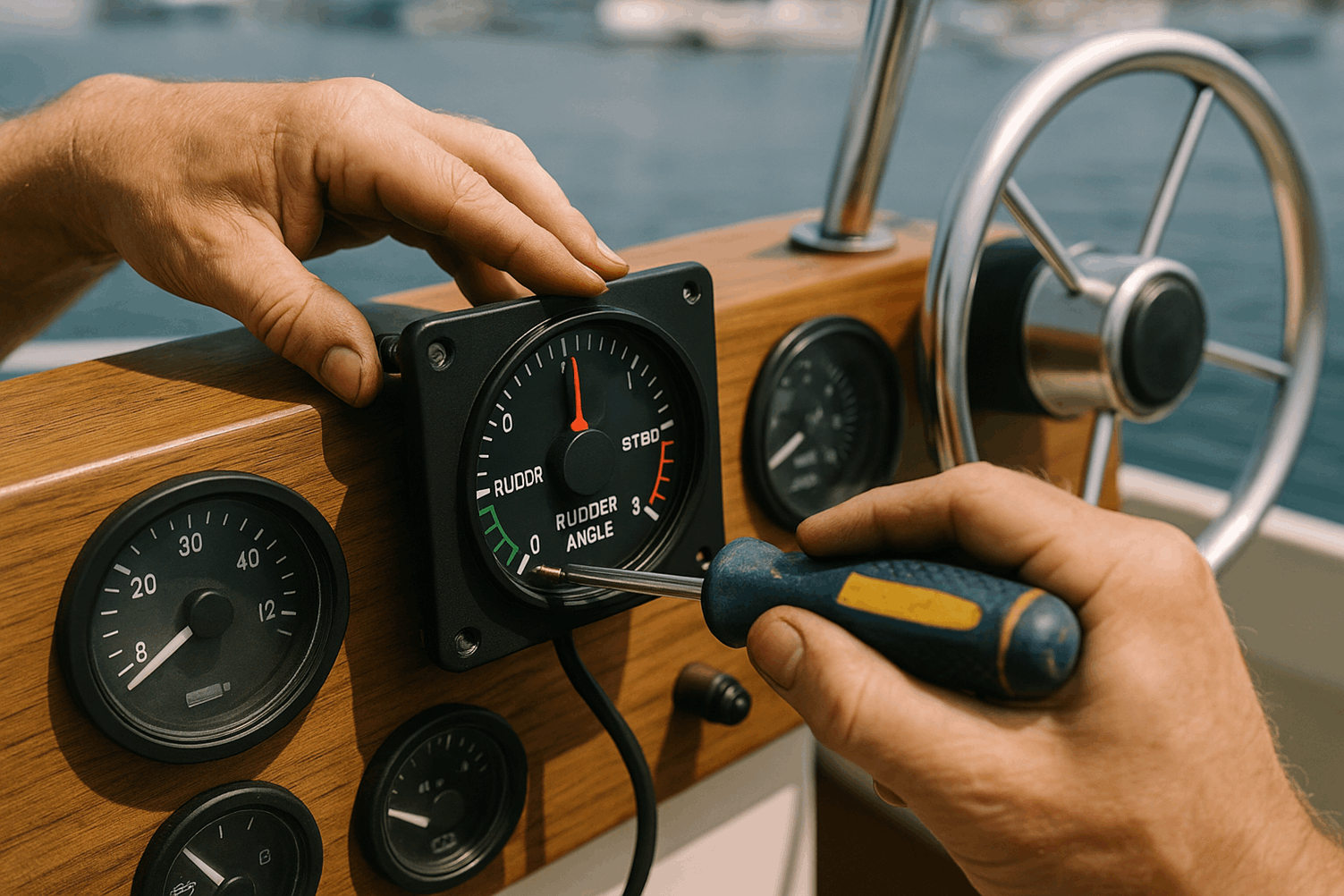
Steering and Manoeuvrability
Navigation allows proper assessment of the vessel’s control systems:
-
Steering precision and smoothness
-
Delays or excessive play in the system
-
Behaviour during tight turns
-
Operation of bow and stern thrusters
-
Low-speed and high-speed handling
These aspects are critical not only for safety, but also for ease of operation and owner confidence.
Hull Behaviour Underway
Many aspects of hull condition and setup only become apparent during navigation:
-
Acceleration and planing behaviour (where applicable)
-
Trim angle and balance
-
Weight distribution
-
Directional stability
-
Structural or hydrodynamic vibrations
-
Noises originating from hull or deck
Alignment issues, past repairs, structural stress or improper setup often reveal themselves only when the vessel is underway.
Auxiliary Systems and Equipment
The sea trial also allows systems to be tested simultaneously and under continuous operation:
-
Engine cooling systems
-
Electrical systems under load
-
Navigation instrumentation
-
Sensors and alarms
-
Autopilot and basic navigation electronics
Many electrical or electronic faults are intermittent and only appear when systems are working continuously.
Common Problems Detected Only During a Sea Trial
One of the greatest values of a sea trial is its ability to uncover issues that would otherwise go unnoticed until after completion of the purchase.
Typical examples include:
-
Engines reaching RPM but not delivering effective power
-
Excessive vibration due to damaged or unbalanced propellers
-
Overheating under sustained load
-
Shaft or engine misalignment
-
Structural noises at specific speeds
-
Steering or autopilot malfunctions while underway
Identifying these issues before signing the purchase contract can prevent costly repairs and disputes.
The Sea Trial as an Objective Decision-Making Tool
A sea trial provides something essential: verifiable technical facts.
It is not based on opinions, impressions or sales claims, but on:
-
Direct observation
-
Actual operating behaviour
-
Comparison with expected performance for the vessel type and model
This allows the buyer to:
-
Confirm the vessel meets expectations
-
Request repairs prior to completion
-
Renegotiate the purchase price on a technical basis
-
Decide not to proceed if risks are excessive
Can a Pre-Purchase Inspection Be Done Without a Sea Trial?
From a technical standpoint, a sea trial should always be carried out whenever possible.
Only in exceptional circumstances—such as operational limitations, lack of propulsion, or yard restrictions—might it be omitted. In such cases:
-
The reason must be clearly stated
-
The limitations must be explained
-
The absence of a sea trial must be expressly noted in the report
Omitting the sea trial without proper disclosure significantly reduces the value of the inspection for the buyer.
Conclusion: When the Boat Shows Her True Condition
The sea trial is the moment when a boat stops being a collection of photographs, invoices and promises, and reveals her true condition.
It is the phase that allows:
-
Real safety assessment
-
Evaluation of reliability
-
Detection of hidden defects
-
Confident and informed purchasing decisions
For this reason, a professional pre-purchase inspection without a sea trial is, in most cases, an incomplete inspection.
